For research use only. Nothing below is medical advice. Talk to your doctor before starting anything, especially if you have an existing health condition.
Epitalon is the other pineal-gland peptide people ask me about, right behind GHK-Cu. Different gland function, different mechanism, same idea: give your body back a signal it made more of when you were younger.
So here’s the deep dive. What Epitalon actually is. What the research actually shows. And since it comes up constantly: why I’d pick Epitalon over Pinealon, its closest cousin, for longevity and cognitive work.
What Epitalon actually is
Epitalon (also called Epithalon or Epithalone) is a synthetic tetrapeptide, four amino acids: alanine, glutamic acid, aspartic acid, glycine, shortened to AEDG. It was built to match the amino acid makeup of Epithalamin, an extract from the pineal gland, the small gland in your brain that runs your sleep-wake cycle and produces melatonin.
Russian researcher Vladimir Khavinson has been studying this family of peptides since the 1980s. Epitalon is the most studied of the group.
What the evidence actually shows
Like basically every peptide in this space, Epitalon doesn’t have a large human RCT behind it, that’s a funding and patent-economics problem across the whole category, not a knock against this specific peptide. What exists instead is over 20 years of lab, cell-culture, and animal research, plus one small but real signal in aging human cells. Here’s what’s actually in it.
It activates telomerase and extends telomeres, in actual human cells. This is the headline finding, and it’s not just theoretical. Telomeres are the protective caps on the ends of your chromosomes, they shorten every time a cell divides, and once they get too short, the cell stops dividing and ages out. Telomerase is the enzyme that rebuilds those caps. The foundational study here, back in 2003, added Epitalon to telomerase-negative human fibroblast cells (a type of skin cell) and triggered telomerase gene expression and measurable telomere elongation. A 2025 follow-up in Biogerontology confirmed it again in normal human breast and fibroblast cells: dose-dependent telomere extension through upregulation of hTERT, the gene that codes for telomerase’s active component. More Epitalon, more effect, a real dose-response relationship, which is a meaningfully stronger signal than a one-off finding.
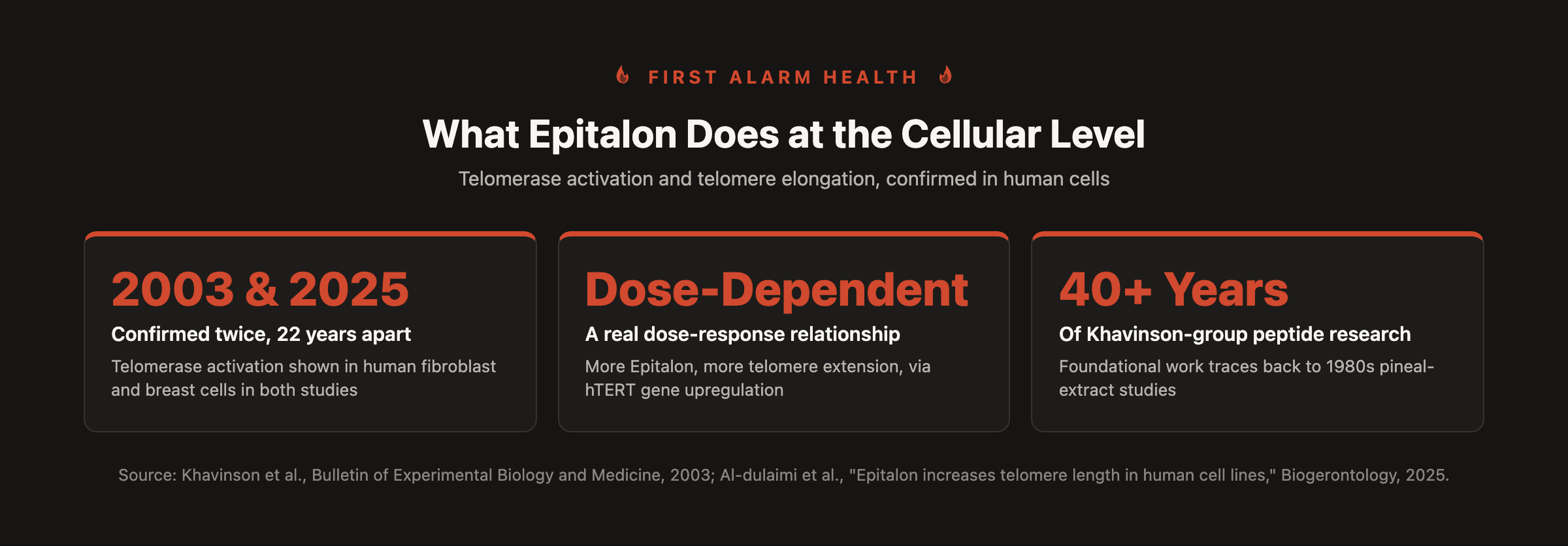
It resets more than one system, not just telomeres. A comprehensive 2025 review in the International Journal of Molecular Sciences lays out Epitalon’s broader effects: antioxidant and antimutagenic activity, direct influence on melatonin production, changes to interleukin-2 (an immune signaling molecule), and increased activity of several enzymes tied to nerve function and aging.
Sleep and circadian rhythm: the mechanism is real, the sleep-outcome trial isn’t there yet. To be straight about this one: nobody has run a study testing whether Epitalon improves sleep directly, that trial doesn’t exist. What does exist is upstream of it. In aged primates, course treatment with Epitalon (and its parent extract, Epithalamin) normalized the daily rhythm of melatonin and cortisol secretion, that’s in vivo animal data, not cells in a dish. Why that matters: melatonin is the hormone that tells your body it’s nighttime, and cortisol is supposed to run low at night and climb toward morning. When that rhythm gets out of sync, whether from aging or shift work, sleep quality is usually one of the first things to go. Epitalon restoring that rhythm in aged animals is a real, plausible mechanism for better sleep. It’s just not the same claim as a human sleep study, and I won’t pretend it is.
One real human data point, heavily caveated. A 2024 case report followed a 79-year-old man who received Epitalon alongside three other interventions at once (plasma exchange, stem cell exosomes, and the peptide Semax) over 16 months. His biological age dropped by 7.9 years and his telomere length increased. Genuinely interesting, but it’s a single patient on four therapies simultaneously, there’s no way to isolate what Epitalon itself contributed. Treat it as a hint worth watching, not evidence Epitalon did that on its own.
Dosing and route
This is general education, not a protocol to follow. Nobody’s run a dose-finding human trial on this, so anything below is industry-reported, not clinically established.
Epitalon is used in short, cyclical courses rather than continuously, 5-10 mg per day by subcutaneous injection for 10-20 straight days, repeated once to three times a year. Evening dosing is the common pattern, timed to line up with your body’s natural nightly melatonin release. Rotating injection sites (abdomen, thigh) helps avoid irritation.
Personally, I’ve seen good results running it lower than that, 1 mg per day for 10 straight days, 2 times a year. Just my own experience, not a recommendation, but worth knowing the range people actually use runs wider than the higher end of the industry-reported protocols above.
The way I think about the split: the higher end of that range, 5-10 mg/day, tends to be for people who are genuinely run down and trying to restore a lot at once, real accumulated damage, not just general upkeep. If you’re already in relatively good shape, 1 mg/day is usually enough to get the same general benefit without needing to push the dose.
What people actually report
There’s no formal safety-trial data here, same as almost every peptide in this category, so this is word of mouth and practitioner-reported experience, not a clinical safety profile. Take it as anecdotal.
Most commonly reported: mild injection-site redness, itching, or irritation that resolves on its own. Some people report mild headaches, dizziness, occasional nausea, or a bit of extra drowsiness when dosing in the evening, which tracks with it nudging your melatonin system.
Why I’d pick Epitalon over Pinealon
People ask about this pairing a lot, since both are short Khavinson-style peptides aimed at aging and brain function. Here’s the honest version:
- Epitalon’s evidence goes deeper and further back. Its telomerase effect has been shown in actual human cells, twice, more than 20 years apart, with a clear dose-response relationship. Pinealon’s evidence is thinner: mostly primate cognitive studies, with far less human cell or human-tissue work behind it.
- The one real human study on Pinealon wasn’t flattering. A 2015 study gave Pinealon (and a comparator peptide, Vesugen) to 32 people with age-related brain and health issues. Pinealon came out the weaker performer of the two, and the researchers flagged real cautions: prooxidant activity and a measurable drop in hematopoietic stem cell markers, meaning it may have suppressed blood cell production to some degree. Epitalon’s data points the other direction, it’s consistently described as antioxidant, not prooxidant.
- Epitalon is meaningfully cheaper. It runs roughly $3-4/mg on average across vendors. Pinealon typically runs $4.50-9/mg for standard vials, more for verified-purity product.
- Epitalon’s regulatory picture is at least clearly documented. It went through the same 2026 FDA compounding review as a lot of other peptides this year, restrictive, but a matter of public record. Pinealon’s status is murkier, sources actively contradict each other on where it stands, which itself isn’t a great sign for how well-established its supply chain and oversight actually are.
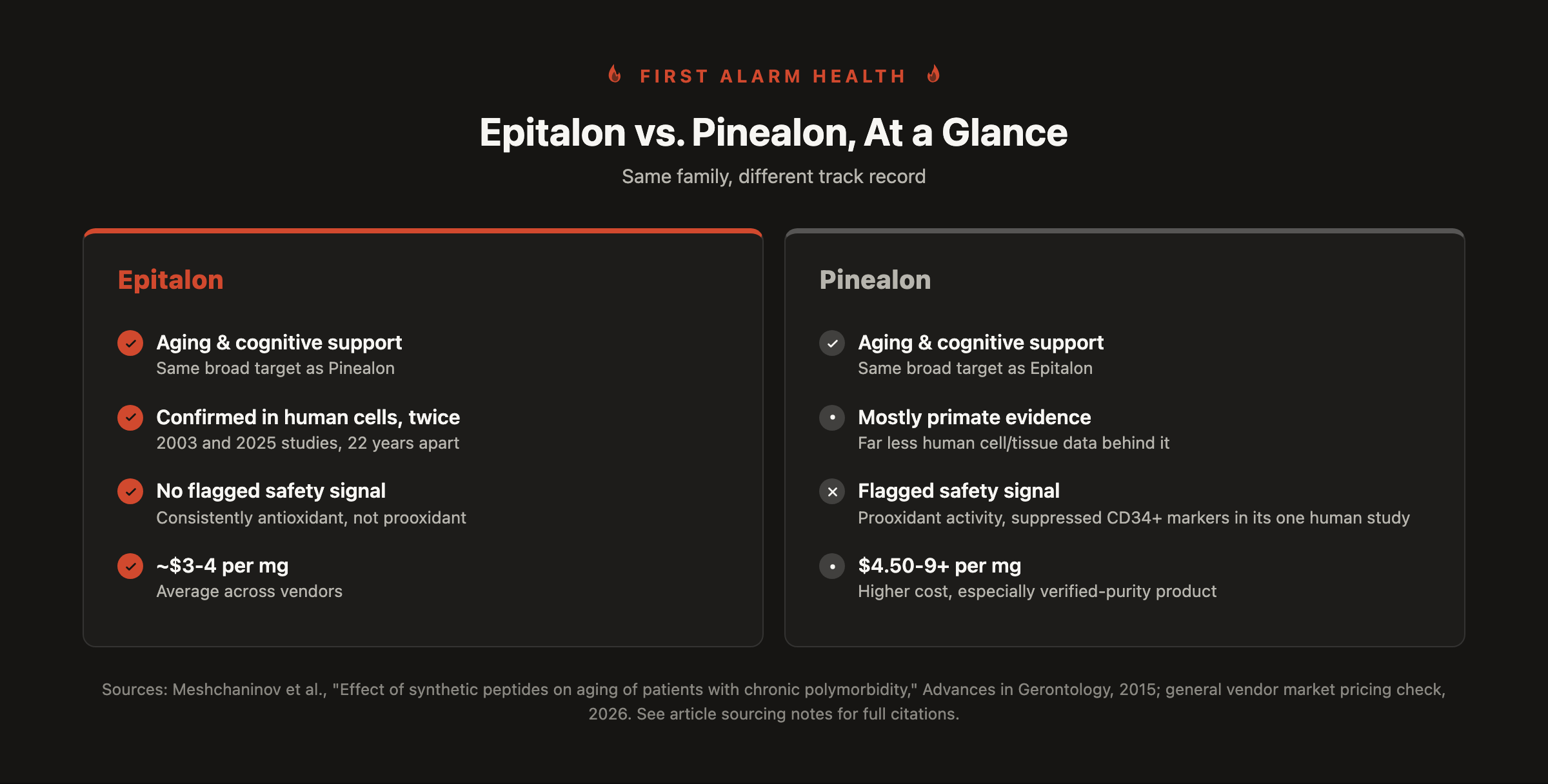
Put those together and Epitalon is the easier call: deeper evidence, no flagged safety signal, lower cost, and a clearer regulatory paper trail.
Bottom line
Epitalon has a real mechanism behind it, telomerase activation and telomere extension confirmed in actual human cells twice over two decades, plus broader antioxidant and neuroendocrine effects shown in aged primates. It’s not RCT-proven, nothing in this category is yet, but it’s one of the better-supported anti-aging peptides out there, and it beats its closest cousin on evidence, safety signal, and price.
For research use only. Nothing here is medical advice.
Shop: First Alarm Health