Most of us show up for the annual physical because we have to. Blood pressure cuff, stethoscope, maybe a treadmill if your department still does stress tests, and you’re back on shift by lunch. But there’s a difference between checking the box on a physical and actually knowing what’s happening inside your body. For this job specifically, that difference matters more than it does for almost anyone else walking around healthy.
Here’s the blunt version. Firefighting does measurable things to your body that you cannot feel happening. Not eventually. Not if you’re unlucky. Measurably, on average, across the whole profession. Bloodwork is the one tool that catches those changes early, while there’s still something you can do about them.
The Two Things This Job Does to You
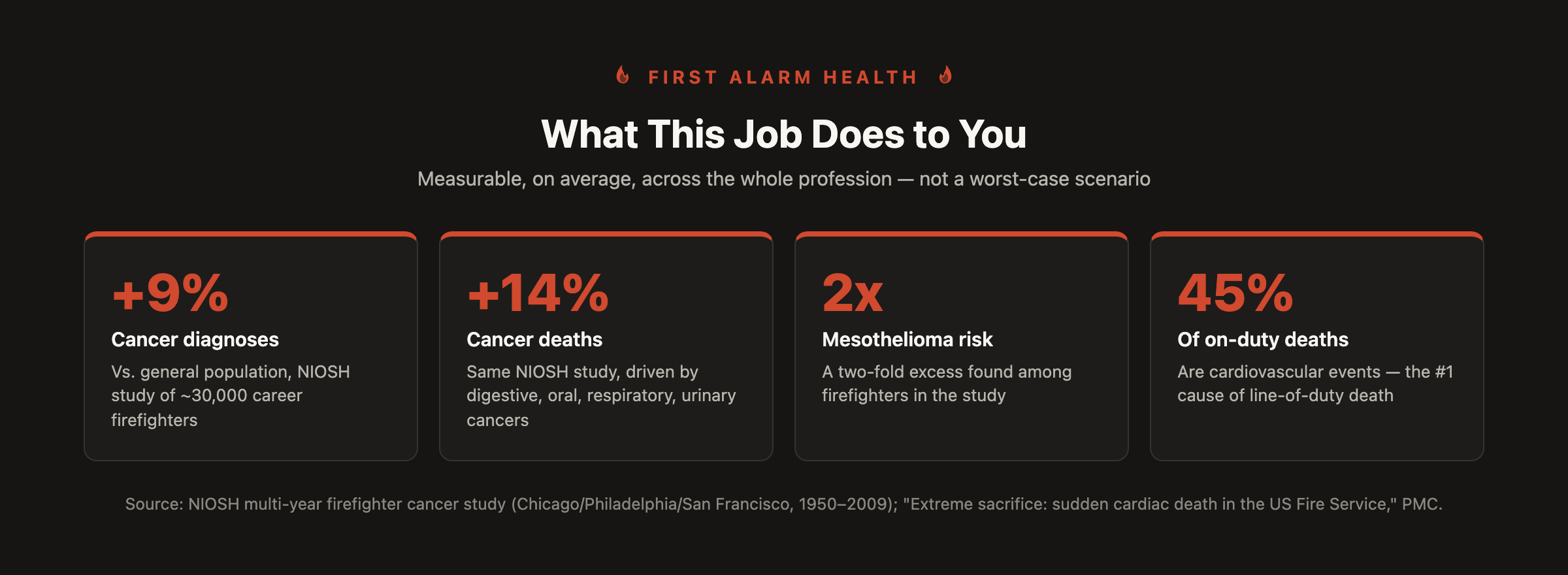
Cancer. NIOSH ran a multi-year study of nearly 30,000 career firefighters from Chicago, Philadelphia, and San Francisco, covering anyone employed between 1950 and 2009. Compared to the general population, that group had a 9% increase in cancer diagnoses and a 14% increase in cancer-related deaths. The increase was driven mainly by digestive, oral, respiratory, and urinary cancers. Researchers found a two-fold excess of malignant mesothelioma. Firefighters in the study had double the expected rate of that specific cancer. The likely driver is exactly what you’d guess: repeated exposure to benzene, formaldehyde, diesel exhaust, and asbestos during fire suppression and overhaul.
Your heart. Cardiovascular disease accounts for roughly 45% of all on-duty firefighter deaths. The single leading cause of line-of-duty death in the fire service. What makes this one sneaky is when it happens. Sudden cardiac events are most likely to strike during or right after fire suppression, even though actual fire suppression makes up only about 1 to 5% of the time we spend on duty in a given year. For every fatal cardiac event on the job, research suggests roughly 17 non-fatal heart attacks and strokes happen to other firefighters in the course of their duties. That’s a lot of close calls nobody hears about at the next union meeting.
Neither of those two things announces itself early. That’s exactly the problem bloodwork is built to solve.
Why a Physical Isn’t the Same as Bloodwork
Your annual physical checks the things a doctor can observe in the room with you. Heart rate, lung sounds, blood pressure, range of motion. Bloodwork checks the things nobody can see. How your liver and kidneys are handling years of combustion byproduct exposure. Where your cholesterol and blood sugar actually sit, not just whether you “look” fit. Whether markers tied to cancers we’re at elevated risk for are trending somewhere they shouldn’t.
There’s also a newer piece of this that’s specific to our gear, not just the fireground. PFAS, the “forever chemicals” found in turnout gear and firefighting foam. The National Academies’ 2022 guidance on PFAS specifically calls out firefighters as a population with elevated exposure worth blood testing for.
If your doctor doesn’t supply a PFAS panel because your department doesn’t currently offer one, that’s not the end of it. Your doctor’s office might still be able to order it independently. If they can’t run it themselves, ask for a referral to a lab that does.
Hormones: The Marker Nobody Wants to Talk About
Guys in this job will describe blood in their stool to a doctor before they’ll admit they’re exhausted all the time, losing muscle they used to hold onto easily, or that their motivation and mood have quietly gone flat. Testosterone carries a stigma in the fire service that it doesn’t deserve. It gets lumped in with steroid scandals and “juicing” instead of being treated as what it actually is: a hormone your body needs, that this job measurably disrupts.
Here’s the mechanism, and it’s not speculation. Testosterone production leans heavily on deep, restorative sleep. Your body drives its biggest testosterone release during that stage of sleep, and shift work fragments exactly that stage. One study screening nearly 7,000 firefighters found almost 40% tested positive for a diagnosable sleep disorder, mostly sleep apnea, insomnia, and shift work disorder itself.
On top of that, chronic occupational stress keeps cortisol elevated. Cortisol and testosterone work like opposite ends of a see-saw. Cortisol directly suppresses the hormonal cascade, the hypothalamic-pituitary-gonadal axis, if you want the technical name, that drives your body’s testosterone production. Put fragmented sleep and chronic stress together, and you have a job that leans on your hormones from two directions at once.
So if you’ve chalked up fatigue, low libido, mood changes, or trouble keeping muscle to “just the job” or “just getting older,” it might be exactly that. Or it might be a measurable, treatable hormone shift. The only way to know the difference is bloodwork, not a guess.
This deserves the same cultural shift the fire service already went through with behavioral health. It used to be nobody brought up depression, anxiety, or PTSD on shift. Now NFPA 1582 itself requires behavioral health screening as a standard part of the annual medical evaluation, because we collectively decided the job affects your mind and that’s worth checking, not hiding.
Hormones are no different. The job measurably affects them. Checking is normal. Treating a real, properly diagnosed deficiency through an actual doctor is no more shameful than treating high blood pressure. And to be clear, this isn’t just a guy’s issue. Women in the department go through their own hormone shifts, particularly around perimenopause and menopause, and the same rule applies. Don’t just push through it. Get it checked.
Not every test is equal, either. Most labs check testosterone with a standard immunoassay, which runs roughly 20% off at lower levels. Ask for mass spectrometry (LC-MS/MS) instead, the more accurate method. Same story with estradiol. Request the “ultra-sensitive” version, since the standard test isn’t built to read the lower levels typical in men.
Thyroid belongs in this same conversation, not off on its own. It’s the hormone that runs your metabolism, energy, body temperature, and mood. The symptoms of it running low look almost identical to the fatigue and flat motivation already covered above, which makes it easy to lump in as “just the job” too.
Chronic stress makes this worse in a specific, sneaky way. Cortisol can suppress the signal your pituitary sends (TSH) and slow down your body’s conversion of T4 into the active thyroid hormone, T3. The result is a pattern where TSH comes back looking “fine” while Free T3 is actually running low. That’s exactly why checking TSH alone can miss a real problem. Free T3 and Free T4 alongside it give you the actual picture instead of just the pituitary’s signal.
(If you want to go deeper on the peptide side of hormone optimization, it’s worth knowing GH-axis peptides like CJC-1295 and Ipamorelin work through a completely different mechanism than TRT. Stimulating your own pituitary to release more of what your body already makes, instead of replacing a hormone directly. I broke that mechanism down in Peptides 101 if you want the fuller picture.)
Inflammation: The Marker That Ties It All Together
If there’s one blood marker that connects everything above, it’s hs-CRP, high-sensitivity C-reactive protein. It’s not the kind of inflammation you feel, like a swollen ankle. It’s the slow-burn, chronic, low-grade kind that sits quietly in the background for years and measurably drives disease.
This one hits close to home for our profession specifically. Firefighters have been found to run elevated levels of inflammatory markers, CRP among them, linked to higher risk of both metabolic and cardiovascular problems. Elevated CRP specifically worsens insulin resistance and raises the risk of the sudden cardiac events covered earlier in this piece.
Shift work adds to it independently of the job itself. One study found hs-CRP levels running noticeably higher in shift workers than in day-shift workers doing the same kind of job. Between the schedule and the work itself, we’re stacking two separate sources of chronic inflammation on top of each other.
This is the marker that ties the cancer risk and the cardiovascular risk together, instead of treating them as two unrelated problems. Chronic inflammation is a recognized driver behind both cardiovascular disease and cancer development. A high hs-CRP isn’t just a number. It’s an early flag that your body’s running hotter than it should, in exactly the two categories this job already stacks the odds against you on.
One practical note: hs-CRP isn’t always part of a standard basic panel by default. If you want it checked, ask for it specifically.
Fasting insulin deserves a mention right alongside it, because it’s arguably the single best early picture of your overall metabolic health. Most guys only get fasting glucose or HbA1c checked, and both of those can sit comfortably “normal” for years while something’s already going wrong underneath.
Here’s why. When your body starts becoming resistant to insulin, your pancreas compensates by pumping out more of it to force blood sugar back into range. That compensation can hold your glucose and even your HbA1c looking perfectly fine for years. Glucose is one of the last things to move, not one of the first. Fasting insulin is what catches the problem while your pancreas is still compensating, instead of after it stops being able to. Given everything above about inflammation and cardiovascular risk, a rising fasting insulin is often the earliest real warning sign you’ll get, well before a standard glucose check would ever flag anything.
I know “lower your chronic inflammation” can sound like a big, vague task to take on. The kind of thing that ends up on a to-do list and never actually gets done. The good news is it’s a lot more manageable than it sounds, and that’s worth its own article rather than a rushed paragraph here. For now, just know that getting these markers checked is the first step. Moving the needle is a lot simpler than you’d think.
What’s Actually in a Solid Panel
If you want a concrete list to bring to your doctor or ask your department’s medical provider about, here’s my personal recommendation from the years of research I’ve done. This is what I personally get checked, at least twice a year:
- CBC with differential: a broad look at your blood cell counts, one of the first things to shift with several cancers
- Comprehensive metabolic panel: liver enzymes, kidney function, electrolytes, and glucose
- Lipid panel: total cholesterol, HDL, LDL, and triglycerides, tied directly to the cardiovascular risk above
- HbA1c: a longer-window look at blood sugar than a single glucose reading gives you
- Fasting insulin: often the earliest sign of metabolic trouble, catching insulin resistance years before glucose or HbA1c move at all
- PSA: prostate-specific antigen, age-appropriate, given our elevated cancer risk profile
- TSH, Free T3, and Free T4: TSH alone can look “normal” while your actual thyroid hormone levels are off. The fuller panel gives you the real picture instead of one piece of it.
- Total and free testosterone, via mass spectrometry (LC-MS/MS): not the standard immunoassay, which runs inaccurate at lower concentrations. Two separate early-morning, fasting draws if the first one comes back low, per Endocrine Society guidance.
- Estradiol, ultra-sensitive assay: the standard version isn’t built to accurately read the lower levels typical in men
- hs-CRP: high-sensitivity C-reactive protein, a marker for chronic inflammation. Not always included by default, so ask for it specifically.
- PFAS panel, if your provider offers it: worth specifically asking about given our gear and exposure history
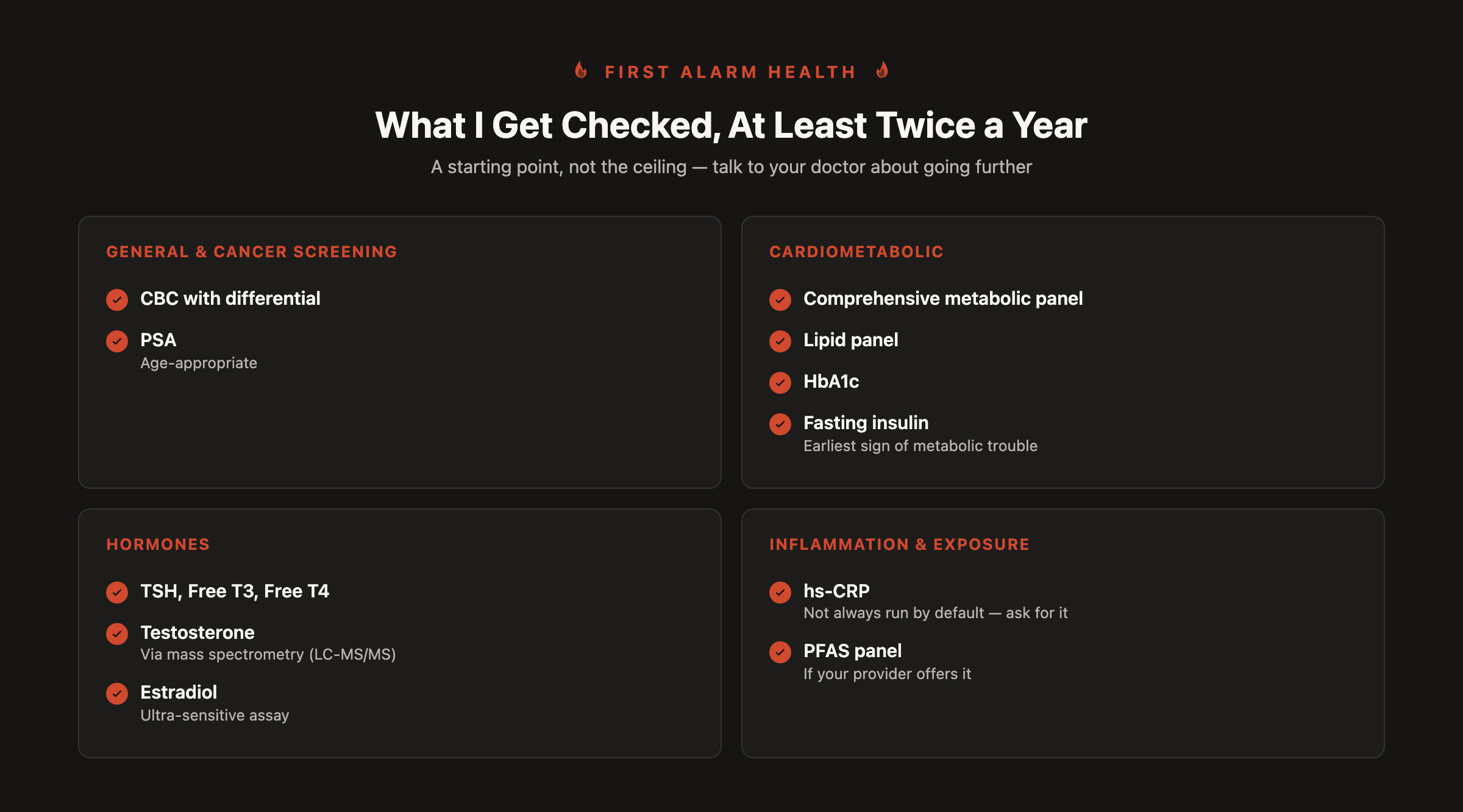
To be clear, this is just a basic baseline. What I think every guy on this job should have as a starting point, not the ceiling. Depending on your own health history, family history, or what you’re specifically trying to figure out, there’s plenty of room to go more nuanced than this list. Talk to your doctor about what makes sense beyond this baseline for you specifically.
The test method matters as much as the marker itself. It’s easy to check a box that says “testosterone” or “estradiol” and get a number back that’s technically wrong for what you actually need. Asking for the specific method by name is a two-second conversation. It’s the difference between a number you can trust and one you can’t.
NFPA 1582, the standard that governs occupational medical programs for fire departments, calls for annual medical evaluations that include comprehensive blood analysis alongside the cardio and pulmonary testing most of us are already used to. Not every department fully funds every piece of that standard. If yours doesn’t, that’s worth raising through the union. In the meantime, nothing stops you from asking your own doctor to run this panel at your regular checkup.
You Don’t Have to Wait on Your Doctor
Here’s something worth knowing. You don’t need a doctor’s appointment to get most of this checked. Direct-access lab testing is legal in 48 of the 50 states. You order the specific test online, walk into a local draw site, usually the same Quest or LabCorp locations your doctor already uses, and get your results without needing a referral or a sit-down appointment first. New York and New Jersey are the exceptions and still require a physician’s order. A handful of states restrict direct access for more complex panels, so it’s worth a quick check on your specific state before you assume it’s available.
It’s also genuinely cheap. I use Dirt Cheap Labs myself. Their $175 panel covers most of what’s in this article, including the mass spec testosterone and ultra-sensitive estradiol. Step up to $295 and you add fasting insulin, a fuller thyroid workup, and a handful of other markers on top of that. If you’d rather pick and choose, they also let you build your own panel starting at $2 per test plus a single $10 draw fee, useful if you just want one or two specific markers instead of a full panel. That’s a real number to plan around, not a guess, and it’s a fraction of what the same tests cost billed through insurance the traditional way.
Here’s what I actually do, and it costs me almost nothing. I go to my own doctor first and ask for these tests specifically, using the same reasoning laid out in this article. Why each one matters, what it catches, what the right test method is. Some of it gets ordered right there, covered like any other bloodwork.
Whatever my doctor won’t order, and there’s usually a handful of items on this list that fall into that category, I go pick up individually through Dirt Cheap Labs’ custom builder instead. I’m not paying for a whole second panel. Just the specific one or two tests that didn’t get covered the first time. Between the two, I end up with everything on this list for barely anything out of pocket.
One more thing that helps the math. These tests qualify as FSA/HSA-eligible medical expenses, so if you’ve got either account, you’re not paying full price out of pocket either way. Dirt Cheap Labs doesn’t run FSA/HSA cards directly at checkout, it’s cash pay at the time of purchase, but they’ll give you an itemized receipt on request, and you submit that to your plan for reimbursement afterward. A few extra minutes of paperwork, and the money comes back.
This isn’t a replacement for your department’s occupational medical program or your own doctor. It’s a way to check your own numbers between official exams, or to specifically get the more accurate test methods (mass spec testosterone, ultra-sensitive estradiol) if your department’s standard panel doesn’t use them. Get a result that concerns you, and the next step is still the same. Bring it to an actual doctor.
The Real Point: Get a Baseline Early
The single biggest mistake I see is waiting. Waiting until something feels wrong. Waiting until you’re 45 and “due” for a real checkup. Waiting until a buddy gets a bad diagnosis before it feels urgent. Bloodwork isn’t just useful as a single snapshot. It’s most useful as a trend line. The earlier in your career you establish your own normal numbers, the easier it is for you and your doctor to spot something moving in the wrong direction years before it becomes a real problem. A number that’s “technically normal” but climbing every year tells a very different story than the same number showing up once.
This isn’t meant to scare anyone. It’s meant to do the opposite. Most of what shows up on these panels is manageable, treatable, or reversible if you catch it early. The whole point of knowing your numbers is that you get to act while you still have options, instead of finding out after you don’t.
This isn’t medical advice. Talk to your doctor about what’s right for you specifically.
Got questions about any of this? Get in touch, happy to talk it through.
Shop: First Alarm Health