For research use only. Nothing below is medical advice. If you have an existing health condition, especially cancer, a family history of it, or anything hormone-related, talk to your doctor before starting anything.
If you’ve talked to me for more than five minutes about peptides, chances are you’ve asked me one of these ten questions. I don’t blame you. The peptide space is loud right now. Most of what’s out there is either fear-mongering dressed up as caution, or hype dressed up as science.
So let’s go myth by myth. Here’s what I actually tell people, backed by the real research. Not internet soundbites.
1. “Peptides cause cancer”
I hear this one more than anything else. I get why. Cancer is terrifying. Almost everyone’s been touched by it personally or through someone they love. Hear a compound described as “stimulating growth” or “supporting regeneration,” and it’s a completely reasonable instinct to wonder if that same mechanism could get hijacked by cancer cells.
But here’s the problem with the blanket statement. Cancer isn’t a switch. It’s not “one pathway turns on, tumor appears.” It’s a multi-step process that unfolds over years. A cell has to acquire a whole list of capabilities at once. Not just one.
There are two versions of this fear I hear most.
Version 1: “GH peptides feed tumors through IGF-1.”
This is the more legitimate version. It deserves a real answer.
In 2020, researchers at Massachusetts General Hospital and Harvard Medical School ran a randomized, double-blind, placebo-controlled trial on tesamorelin. It’s a GHRH analog, meaning it doesn’t inject growth hormone directly. It stimulates your own pituitary to release it. The trial ran 12 months in people with HIV-associated fatty liver disease. Here’s the part that matters. They took liver biopsies at the start and at 12 months, then ran a full transcriptomic analysis. Checking the actual gene expression tied to liver cancer risk.
Every single cancer-relevant pathway they measured moved in the favorable direction. Genes tied to a good liver-cancer prognosis went up. Genes tied to a poor prognosis went down. Markers of uncontrolled cell division, one of the actual hallmarks of cancer, went down. Not up.
On the IGF-1 question specifically: yes, tesamorelin raised IGF-1. But it stayed within the normal physiological range. Tesamorelin restores your body’s natural pulsatile GH release. It doesn’t flood your system the way abusive, supraphysiologic GH doses do. The cancer concern with the GH/IGF-1 axis has always been about chronically elevated, abnormal hormone levels. Not about a GHRH analog nudging your own production back toward normal.
To be fair, this was a small study. 18 people on tesamorelin, 21 on placebo, in a population that already had HIV and liver disease. Twelve months is short relative to how long cancer actually takes to develop. Gene expression doesn’t always translate perfectly into real-world outcomes.
But “peptides cause cancer” isn’t an accurate way to describe what the best available data on tesamorelin actually shows. And this is specific to GH-axis peptides at physiological doses. It doesn’t apply to a peptide like BPC-157, which doesn’t touch the GH/IGF-1 axis at all.
Version 2: “Healing peptides cause cancer through angiogenesis.”
This is the one that comes up most with BPC-157 and TB-500. The logic usually goes like this: these peptides support tissue repair. Tissue repair involves angiogenesis, new blood vessel growth. Tumors also use angiogenesis to grow. Therefore these peptides cause cancer.
Here’s where that reasoning breaks down. One mechanism doesn’t equal one outcome. For a peptide to actually drive cancer, it would need to meaningfully push multiple of the recognized “hallmarks of cancer” in a tumor-friendly direction at once. Not just support one part of normal healing.
Angiogenesis by itself isn’t the villain here. Your body needs it for wound healing, muscle recovery, and connective tissue repair. If angiogenesis were automatically cancer-causing, injuries would never heal. And tumors are fully capable of hijacking angiogenesis on their own. They don’t need help from a peptide to do it.
Right now, there isn’t strong human evidence that BPC-157 or TB-500-associated angiogenesis at normal doses meaningfully increases tumor initiation or progression. Most of the fear here is theoretical extrapolation, not outcome data. Which means “these peptides cause cancer” gets stated with a lot more confidence than the evidence actually supports.
That’s not the same as calling them risk-free, though. We don’t have long-term human cancer-outcome trials for most peptides. Anyone telling you “100% safe” or “100% dangerous” is overreaching either direction.
The better question to ask: instead of “does this peptide involve growth or repair,” ask what it’s doing to your overall biological terrain. Cancer thrives in an environment that’s chronically inflamed, metabolically dysfunctional, and sleep-deprived. Peptides that reduce inflammation or improve recovery may actually support a less cancer-permissive environment overall. They’re not a cancer treatment, though, and I’d never frame them as one.
One important note. If you have active cancer, a recent cancer history, an unexplained mass, or a high genetic risk, talk to your medical team before starting any peptide. That’s not a disclaimer to cover myself. It’s just the responsible answer.
2. “Peptides are the same as steroids”
This one usually comes from a good place. People hear “hormone” and “injection” in the same sentence and assume it’s all one bucket. It’s not. And the difference matters more than most people realize, because this isn’t just a “these work differently” story. It’s a “these have completely different risk profiles” story.
Let’s start with steroids, because the damage they can do is well documented.
Anabolic steroids, testosterone, Primobolan, Equipoise, are fat-soluble molecules. They cross directly into your cells and bind to the androgen receptor sitting in the cytoplasm. That receptor-hormone complex travels into the nucleus and binds your DNA directly. It rewrites which genes get switched on, cranking up protein synthesis and building muscle tissue.
That’s powerful. It’s also blunt. Androgen receptors exist everywhere in your body. Your heart, your liver, your blood vessels, your skin.
Long-term steroid use is linked to dropped HDL and raised LDL cholesterol, arterial stiffness, elevated blood pressure, cardiomyopathy, left ventricular hypertrophy. Particularly with oral 17-alkylated compounds, real liver toxicity, up to and including liver tumors in severe cases.
The HAARLEM study, one of the major long-term studies on steroid-using athletes, documented premature atherosclerosis and actual cardiac structural damage as a direct result of long-term androgen use. Even the “milder” compounds aren’t exceptions. Equipoise still pushes your lipid profile the wrong direction. Injectable Primobolan skips first-pass liver toxicity, but it’s not free of cardiovascular strain either.
Now compare that to peptides like Retatrutide, Tesamorelin, and BPC-157.
In phase 2 trials, Retatrutide’s most common side effects were GI-related. Nausea, diarrhea, vomiting. Almost entirely tied to how fast the dose was escalated. Serious adverse events happened at the same rate as placebo, 4% in both groups.
Tesamorelin’s known side effects, fluid retention, insulin resistance, carpal tunnel, come from pushing GH pharmacologically high. Not some hidden organ-damage mechanism. BPC-157’s studied side-effect profile is minimal by comparison.
None of these carry the documented cardiomyopathy, atherosclerosis, or liver tumor risk that steroids do.
Why the difference? It comes back to mechanism. Steroids get inside the cell and rewrite your genetics directly. A blunt tool that acts everywhere androgen receptors exist. Peptides like these work from outside the cell, nudging systems your body already has: pituitary GH release, GLP-1/GIP metabolic signaling, VEGFR2-driven tissue repair. Instead of overriding your genetics.
That’s why the damage profile is so different. Not a coincidence. The mechanism.
Bottom line: peptides and steroids aren’t the same category of risk. It’s not close.
3. “Once you start peptides, you can’t get off them”
The real version of this fear is legitimate. It’s just aimed at the wrong category.
Actual hormone shutdown happens with things like anabolic steroids or exogenous testosterone. Here’s the mechanism. Your hypothalamus detects the synthetic hormone, reads it as “we’ve got plenty of testosterone already,” and dials back GnRH. That cuts LH and FSH, which shuts down your testes’ own production and can cause testicular atrophy. That’s a real negative-feedback shutdown. It’s what people are actually picturing when they say “can’t get off it.”
GH-secretagogue peptides like CJC-1295 and Ipamorelin don’t work that way. They work upstream, prompting your own pituitary and hypothalamus to release more of what your body already makes, instead of replacing a hormone directly.
Ipamorelin was specifically developed to be selective (Raun et al., 1998, European Journal of Endocrinology). It releases GH without meaningfully spiking cortisol, prolactin, or ACTH, unlike older-generation GHRPs. CJC-1295 (Teichman et al., 2006, Journal of Clinical Endocrinology & Metabolism) produces a sustained, dose-dependent rise in GH and IGF-1 over several days per dose. None of the studies on it show the kind of negative-feedback shutdown steroids cause.
I’ll be fully honest here. That doesn’t mean zero long-term unknowns exist. There’s a theoretical concern about receptor desensitization with chronic use, and no human study has tracked this much past 90 days. So the accurate claim isn’t “totally risk-free forever.” It’s “there’s no evidence of the steroid-style shutdown mechanism, and long-term data is thin either way.”
This is exactly why cycling matters. It’s worth actually explaining instead of just telling you to do it.
Receptor desensitization is real. It’s your cells’ natural defense against overstimulation. Stimulate a receptor chronically enough, and the cell responds by internalizing it, restructuring it, or reducing how many sit on the surface. It takes more peptide to get the same effect over time.
The GHS-R1a receptor, the target for GH secretagogues like GHRP-6 and Hexarelin, is a well-documented example. It internalizes within about 60 minutes of activation. It can take up to 6 hours for surface receptors to recover. Overstimulate that system without a break, and you end up needing more and more peptide for less and less effect.
That’s the actual reason behind cycling protocols. Not superstition. Giving receptors a genuine reset window before you start again. Common examples: 5 days on, 2 days off, weekly. Or for GH secretagogues specifically, 8 to 12 weeks on, 4 to 6 weeks off.
This isn’t universal, though. GHRP-6 and Hexarelin desensitize within weeks. BPC-157 seems to hold its effectiveness through typical protocol lengths without needing the same cycling. So “should I cycle this” is, like most of these questions, a “which peptide” answer. Not a blanket rule.
For peptides like BPC-157 or TB-500, tissue repair peptides, this whole question barely applies. They’re not working through a hormone feedback loop in the first place.
Bottom line: the shutdown people are actually afraid of is a steroid problem, not a peptide problem. But cycling GH-axis peptides is still smart, for a completely different reason: keeping your receptors responsive, not avoiding a hormonal crash.
4. “All peptides are the same”
I get this one constantly. It makes sense. “Peptide” sounds like one category, so people assume one set of rules applies to all of them. It doesn’t. “Peptide” describes a chemical structure, short chains of amino acids, not a function. What they actually do depends entirely on which peptide and which receptor it’s targeting.
Here’s the actual breakdown:
- Healing/recovery peptides: BPC-157, TB-500. Tissue repair, connective tissue healing, inflammation modulation. Nothing to do with hormones.
- GH-axis peptides: CJC-1295, Ipamorelin, Sermorelin, Tesamorelin. Stimulate your own pituitary to release more growth hormone. This is the category the cancer and “shutdown” conversations above are actually about. It doesn’t apply to the other categories.
- Metabolic/weight peptides: semaglutide, tirzepatide, Retatrutide. GLP-1/GIP/glucagon receptor agonists affecting appetite and metabolism. Retatrutide, a triple agonist across all three receptors, showed up to 24.2% mean weight loss at 48 weeks in phase 2 obesity trials. One of the most aggressive results in this entire category. This is also the category with the most FDA-approved drugs behind it. Over 100 peptide drugs now have market approval.
- Cosmetic/anti-aging peptides: GHK-Cu, Epitalon. GHK-Cu is a naturally occurring copper-binding peptide that declines with age. Plasma levels drop from around 200 ng/mL at 20 to around 80 ng/mL by 60. It delivers copper to enzymes that drive collagen and elastin production. One study found 70% of women using GHK-Cu showed increased collagen production over a month, compared to 50% with vitamin C cream and 40% with retinoic acid.
- Cognitive peptides: Semax, Selank. Studied for memory, anxiety, brain function.
- Immune peptides: Thymosin Alpha-1. Immune system support and modulation.
- Sexual health peptides: PT-141. A completely different mechanism again, working through melanocortin receptors.
Bottom line: “is this peptide safe” is never a one-size-fits-all question. The right question is always “which peptide, for what purpose.” The same way you wouldn’t lump ibuprofen and insulin together just because they’re both “medications.”
5. “Higher doses work better, or faster”
This is one of the most consistent mistakes I see. The evidence against it is genuinely strong, from two completely different angles.
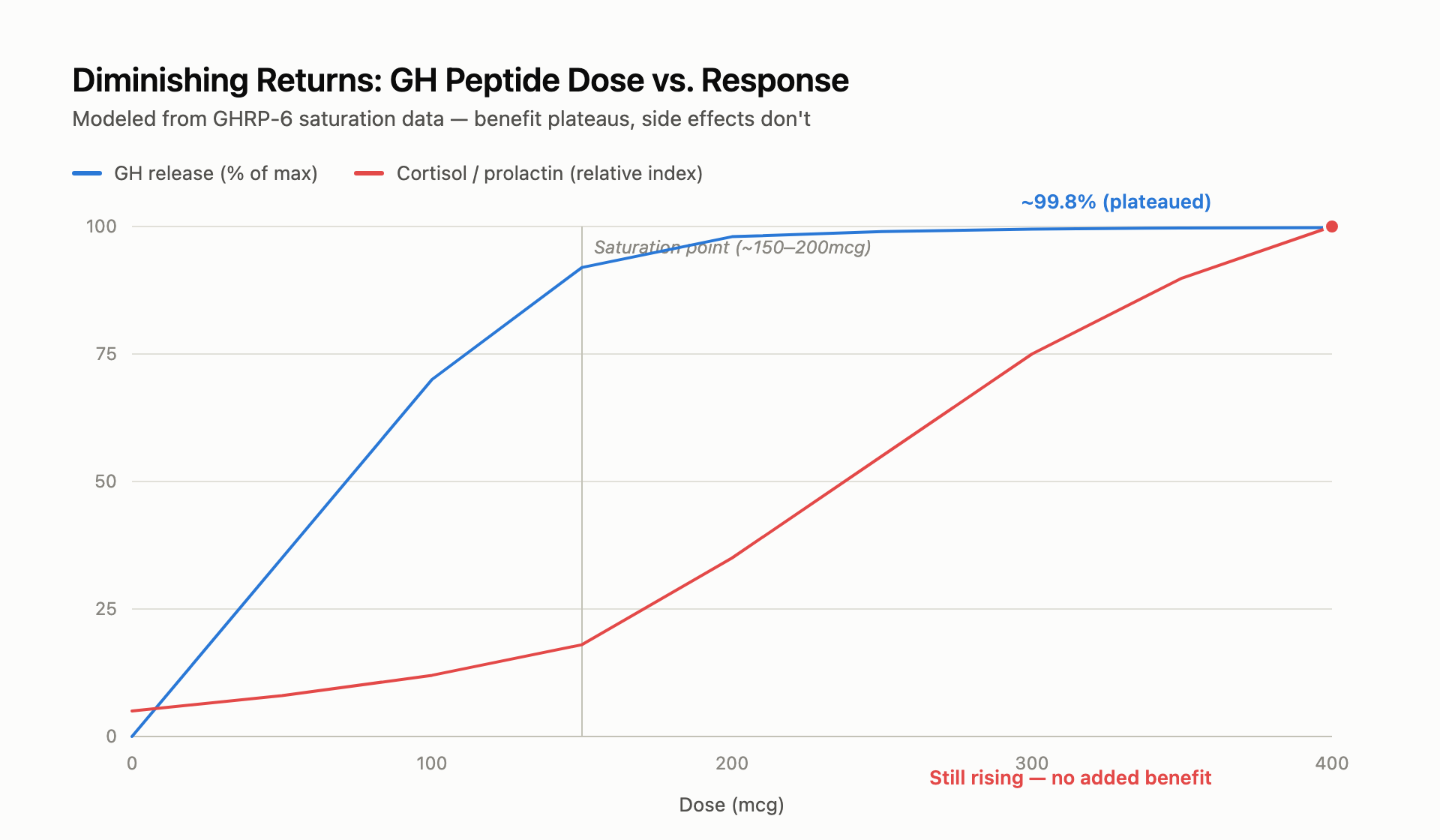
The ceiling effect. Dose-response curves for GH-releasing peptides plateau early. Commonly cited around 100 to 200 mcg per dose for something like GHRP-6, roughly 1 mcg per kilogram of bodyweight. Push past that saturation point and you don’t get proportionally more GH release. Your pituitary is already responding close to its max. What you do get more of is cortisol and prolactin. More side effects for zero extra benefit.
There’s a second ceiling stacked on top of that one. GH still has to convert to IGF-1 in your liver, and that conversion caps out too. So even a “perfect” pituitary response only translates to so much usable effect downstream. Chasing bigger numbers with bigger doses mostly buys you side effects, not results. The curve flattens out much earlier than people assume.
The inverted-U pattern. This shows up across peptide hormones broadly. Oxytocin is one of the best-studied examples. Multiple studies show an inverted-U dose-response curve, where moderate doses (8 to 24 IU) produced better outcomes on things like emotion recognition and trust than higher doses did. Past a certain point, more oxytocin didn’t just plateau. In some contexts it actually reversed the benefit.
That rise-peak-decline pattern shows up across multiple peptide and hormone systems. It’s a big reason “if some is good, more must be better” is a bad assumption to carry into peptide use in general.
Bottom line: for any peptide with a defined receptor or feedback system, there’s almost always a point of diminishing, or even reversing, returns. It usually arrives earlier than people expect. Dialing in the right dose beats maximizing it, every time.
6. “Peptides = instant results”
True and false at the same time. Peptides typically start acting on your body immediately at the biochemical level. But “acting” isn’t the same as “visible results.” That gap is where this myth comes from.
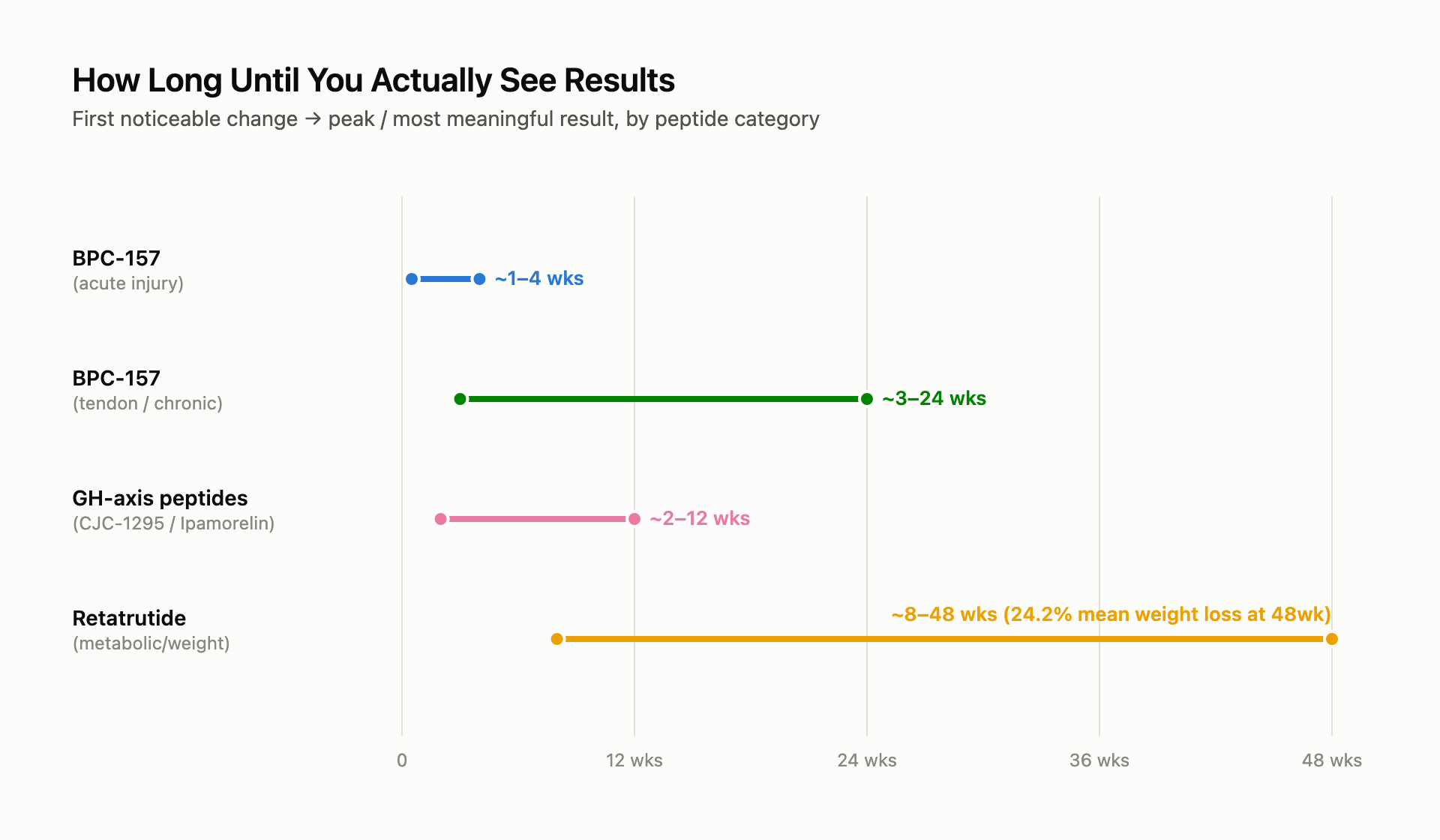
Healing peptides (BPC-157): acute injuries often show noticeable improvement in 3 to 7 days, with more significant healing over 2 to 4 weeks. Tendon and ligament injuries take longer. Early mobility improves in weeks 2 to 4, but actual structural repair takes 3 to 6 months. Chronic conditions like tendonitis typically need 4 to 8 weeks of consistent use before substantial improvement, with peak results generally landing in that same window as tissue remodeling and collagen synthesis peak.
One thing worth knowing: BPC-157’s anti-inflammatory effect kicks in before structural healing does. Pain going away doesn’t mean you’re fully healed. That’s a common false “I’m done” signal.
GH-axis peptides (CJC-1295/Ipamorelin): sleep and energy improve in weeks 1 to 4. Visible body composition changes show up around months 2 to 3. Skin and anti-aging benefits generally take 4 to 6 months or more. And realistically, body composition change over that window tends to be more modest than people expect. Think single-digit body fat shifts, not a dramatic transformation.
Metabolic peptides (Retatrutide): this is the clearest “slow, then meaningful” example there is. Phase 2 trial data shows the first month brings minimal scale movement despite consistent use. Weight loss accelerates in weeks 8 to 16. The most dramatic results show up between months 6 and 12.
Concretely: participants averaged 17.5% mean weight loss at 24 weeks, climbing to 24.2% at 48 weeks. About 58 pounds over 11 months at the highest studied dose. That’s a real, well-documented result. It’s also an 11-month result, not a first-month one. Anyone expecting a dramatic change in week two is setting themselves up to quit right before the curve actually bends.
The thing that matters most across every category: results are consistently strongest in people who pair the peptide with dialed-in nutrition, resistance training, and sleep. Not the peptide working alone. Skip those fundamentals, and you’re getting a fraction of what the peptide is capable of.
Bottom line: peptides start working on day one. You just won’t see it on day one. Give it the actual timeline, and stack the fundamentals on top of it.
7. “Peptide pills work just as well as injections”
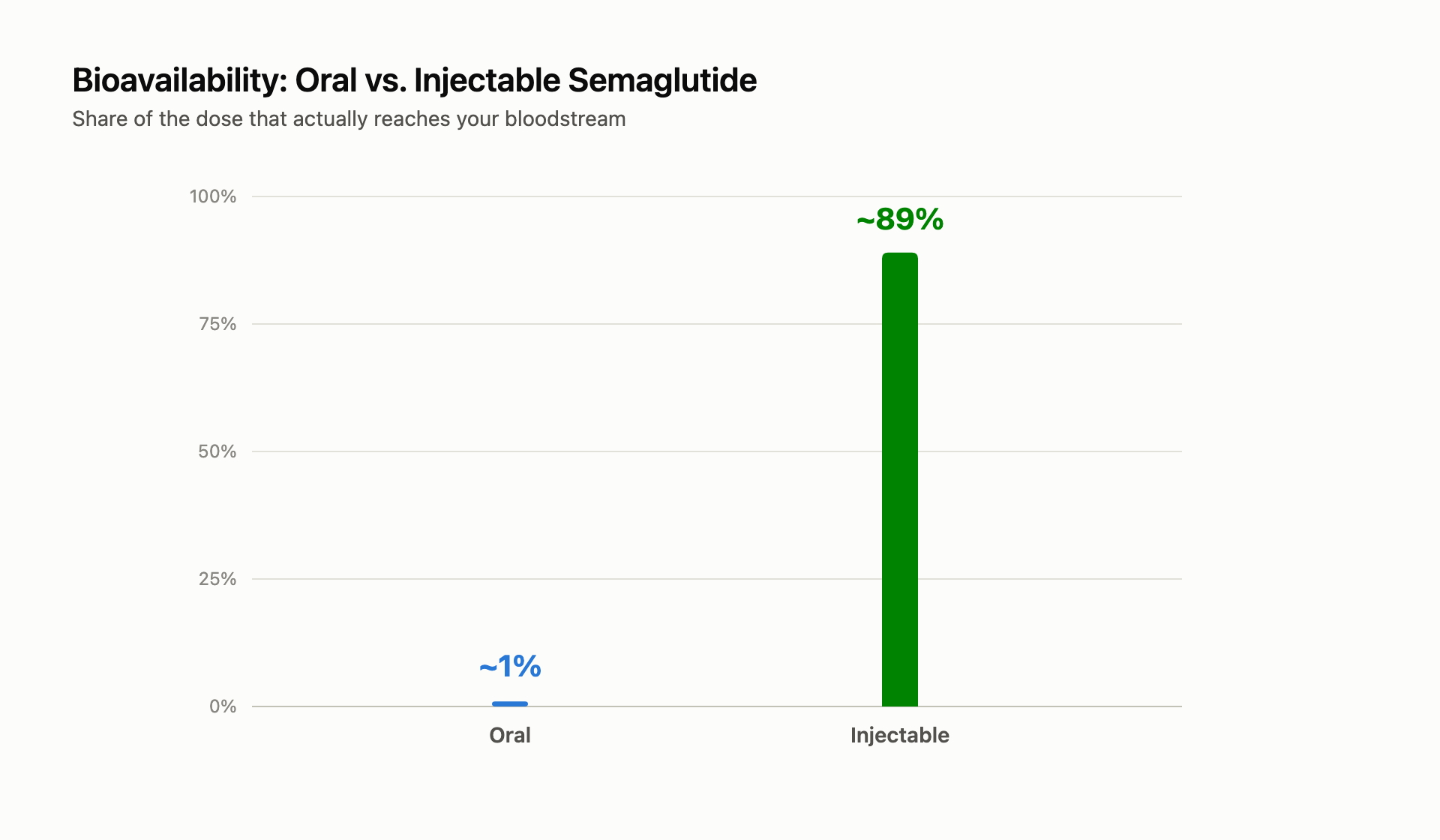
This isn’t close, and the data on why is genuinely clear. Injected peptides hit roughly 100% bioavailability. Essentially all of it reaches your bloodstream. Oral peptides typically have less than 1 to 2% bioavailability. The reason: stomach acid and digestive enzymes rapidly break peptide bonds before they can be absorbed. Whatever survives the stomach runs into a second wave of enzymes in the small intestine.
The clearest real-world example is oral versus injectable semaglutide. Oral bioavailability is only about 0.4 to 1%, compared to roughly 89% for the injectable version. That’s why the oral dose is so much higher. 14mg oral is dosed to try to match roughly 0.5mg injectable, about a 28-to-1 ratio. Of that 14mg swallowed, only around 0.14mg actually makes it into circulation. You need roughly 100 times the oral dose to match what an injection delivers.
And this shows up in real outcomes, not just lab numbers. In real-world 2-year data, people on oral semaglutide lost an average of 8.7 pounds, compared to 16.7 pounds for people on the injectable. Essentially half the result, despite the oral version using absorption enhancers and requiring strict fasting conditions just to get what little absorption it does.
Now, the part I actually want to spend time on: the fear of the needle itself. A lot of people who’d otherwise consider peptides get stuck right here. “I don’t want to inject myself.” That fear is almost always bigger than the reality.
Peptides are dosed subcutaneously, just under the skin into the fat layer, using tiny insulin syringes. Typically 29 to 31 gauge, half an inch long. That gauge is thin enough that most people describe it as a mild pinch, not a sting. The fat layer you’re injecting into has comparatively few blood vessels or nerve endings, so the odds of a painful or bloody injection are low from the start.
The actual process is genuinely simple. Same handful of steps every time. Wipe the vial top with an alcohol swab. Draw your dose into the syringe using the markings. Pinch a bit of skin at your injection site, stomach or upper thigh are the most common spots. Press the plunger slowly over 2 to 3 seconds.
Rushing the injection is actually one of the main causes of soreness or a small lump afterward. Not the needle itself. Do it two or three times, and it becomes a 30-second part of your routine, not something to dread.
Bottom line: pills aren’t “worse by a little.” Digestion is specifically built to break down proteins, which is exactly what makes oral peptides so hard to deliver. And the injection itself is a lot less intimidating than people assume before they’ve actually done it.
8. “Dosing timing doesn’t matter”
“Depends which peptide” is the honest answer. The reasons why are actually interesting.
GH-axis peptides (CJC-1295/Ipamorelin): timing matters a lot here. Insulin is a direct antagonist of growth hormone. When insulin is elevated, which happens after eating, especially carbs or fat, it blunts the GH pulse these peptides are trying to create. That’s why the standard protocol is dosing 30 to 45 minutes before bed, on an empty stomach, 2 to 3 hours since your last meal, and waiting at least 30 minutes after injecting before eating again.
This timing isn’t arbitrary. It stacks two things in your favor. It lines up with your body’s natural GH peak during early sleep. And it keeps insulin low enough that it doesn’t cancel out the pulse.
Healing peptides (BPC-157): timing relative to meals is basically irrelevant, since it’s injected and bypasses digestion entirely. Workout timing has some theoretical logic on both sides. Pre-workout, 30 to 60 minutes before, is argued to prime the repair cascade before tissue stress happens. Post-workout, 15 to 30 minutes after, once your heart rate settles, is argued to catch the natural inflammatory and recovery window. But there’s no strong clinical data favoring one over the other. BPC-157 works systemically over hours and days, not minutes. The exact-minute question matters far less than most people assume.
Bottom line: consistency beats precision. Pick a time you’ll actually stick to, whether that’s dictated by real physiology (GH peptides, empty stomach, bedtime) or just personal routine. The discipline of doing it daily matters more than optimizing the exact minute.
9. “Peptides don’t have enough human data, so they must be dangerous”
This is probably the single biggest reason people who’d otherwise try peptides talk themselves out of it. It’s worth taking seriously instead of brushing past it, because the reasoning contains a real logical error worth naming. Absence of evidence is not evidence of absence. Not having proof something is safe is a completely different claim than having proof it’s dangerous. Medical researchers actually have a name for this exact reasoning trap. It trips up smart people constantly.
Here’s why the data gap actually exists, and it has nothing to do with safety. Getting a compound through the full FDA approval pipeline costs $1 to $2 billion and takes 10 to 15 years. That investment only makes sense for a pharmaceutical company if they can patent the compound and sell it exclusively long enough to recoup the cost.
Most of the peptides people ask me about, BPC-157 especially, are naturally-derived sequences that are difficult or impossible to patent. A company could spend a billion dollars proving it works, and a compounding pharmacy could legally make a generic version the next day. Nobody’s going to fund that.
This is a market problem. Not a safety signal.
But I want to be honest instead of one-sided here. The full picture has real nuance in both directions.
On one hand, there’s more human data than people assume. BPC-157 actually did go through Croatian human trials in the late ’90s and early 2000s, sponsored by Pliva, at the time one of the largest pharma companies in Eastern Europe, studying it as an IBD treatment under the names PL-10, PLD-116, and PL14736. Phase 1 safety data showed it was safe and well-tolerated in healthy volunteers. That data was never published in a major indexed journal and no full randomized trials followed. But “zero human data” isn’t quite accurate either.
And for peptides like Retatrutide, Tesamorelin, and semaglutide, there’s extensive FDA trial data. This is very peptide-specific, same as everything else on this list.
On the other hand, real skepticism here deserves airtime too. A University of Utah chief medical resident who reviewed the BPC-157 literature put it bluntly: “We’ve cured cancer in mice plenty of times. Haven’t done it in people yet.” A fair point about how far animal data actually extends.
The FDA added BPC-157 to its list of substances compounding pharmacies shouldn’t use in 2023, citing potential safety risks. And it’s worth knowing that much of the foundational animal research comes from one research group whose lead scientist has undisclosed patent interests in BPC-157. A real conflict of interest that should make anyone read the rosier claims with some skepticism.
Here’s a quick human-data status check, peptide by peptide. “Lack of data” isn’t a blanket truth across this whole category:
- Tirzepatide & Semaglutide: fully FDA-approved (Mounjaro/Zepbound, Ozempic/Wegovy), backed by large Phase 3 global trial programs spanning multiple countries, including Japan.
- Tesamorelin: FDA-approved (Egrifta) with real Phase 3 human data. The same tesamorelin from the cancer study earlier in this article.
- Retatrutide: not yet FDA-approved, but backed by substantial published Phase 2/3 human trial data.
- Ipamorelin: never reached FDA approval, but does have real Phase 1 human data. A dose-escalation study in healthy male volunteers found no serious adverse events, dose-proportional pharmacokinetics, and confirmed its selective GH release without spiking cortisol or prolactin.
- Semax & Selank: not FDA/EMA approved, but both are registered, approved medications in Russia with real human trial data behind them. Selank completed Phase III trials for anxiety and was approved by the Russian Ministry of Health in 2009. Semax has human stroke-recovery trial data showing increased BDNF and faster functional recovery. “No FDA approval” here means “not approved in the US.” Not “never tested in humans anywhere.”
And this list barely scratches the surface. Roughly 130 peptide drugs currently have FDA approval across metabolic, hormonal, and oncology use. Insulin and its analogs, liraglutide (Victoza/Saxenda), dulaglutide (Trulicity), exenatide (Byetta/Bydureon), oxytocin (labor induction), octreotide (Sandostatin, for acromegaly). The category most people picture as “unregulated research chemicals” actually includes some of the most established, decades-old drugs in modern medicine.
Bottom line: lack of large-scale human trials means the safety profile is unproven, not that it’s proven dangerous. But it also doesn’t mean it’s proven safe. The right response to genuine uncertainty isn’t “assume the worst” or “assume it’s fine.” It’s acknowledging what’s actually known, what isn’t, and making your own call with real information instead of a knee-jerk “no FDA approval equals dangerous” reflex.
10. “Storage and shelf life don’t matter”
This one’s more nuanced than either extreme people assume.
Lyophilized (freeze-dried, unreconstituted) peptides are the stable form. Stored properly, cold, dark, dry, they remain stable 12 to 24 months in the freezer at -20°C, and 6 to 12 months refrigerated. Peter Magic, founder of Janoshik Analytical, has run tens of thousands of peptide purity tests. His data shows properly lyophilized peptides can stay stable for years refrigerated, and over a decade frozen.
Heat above roughly 45°C and UV light are the real enemies. That’s why keeping vials in original packaging, away from light and heat, actually matters.
Reconstituted (mixed with liquid) peptides are a different story. Once water is reintroduced, degradation pathways reactivate. Standard guidance: refrigerate at 2 to 8°C and use within 28 days.
But here’s the part that Janoshik’s testing actually revealed. The 28-day rule isn’t really about the peptide molecule dying. It’s a sterility limit. It traces back to FDA-labeled guidance for bacteriostatic water once a vial’s seal is punctured, not a chemical expiration date on the peptide itself. Janoshik’s data shows the peptide molecule is often stable well past 30 days. The real risk at that point is microbial contamination from repeated needle punctures, not the peptide breaking down.
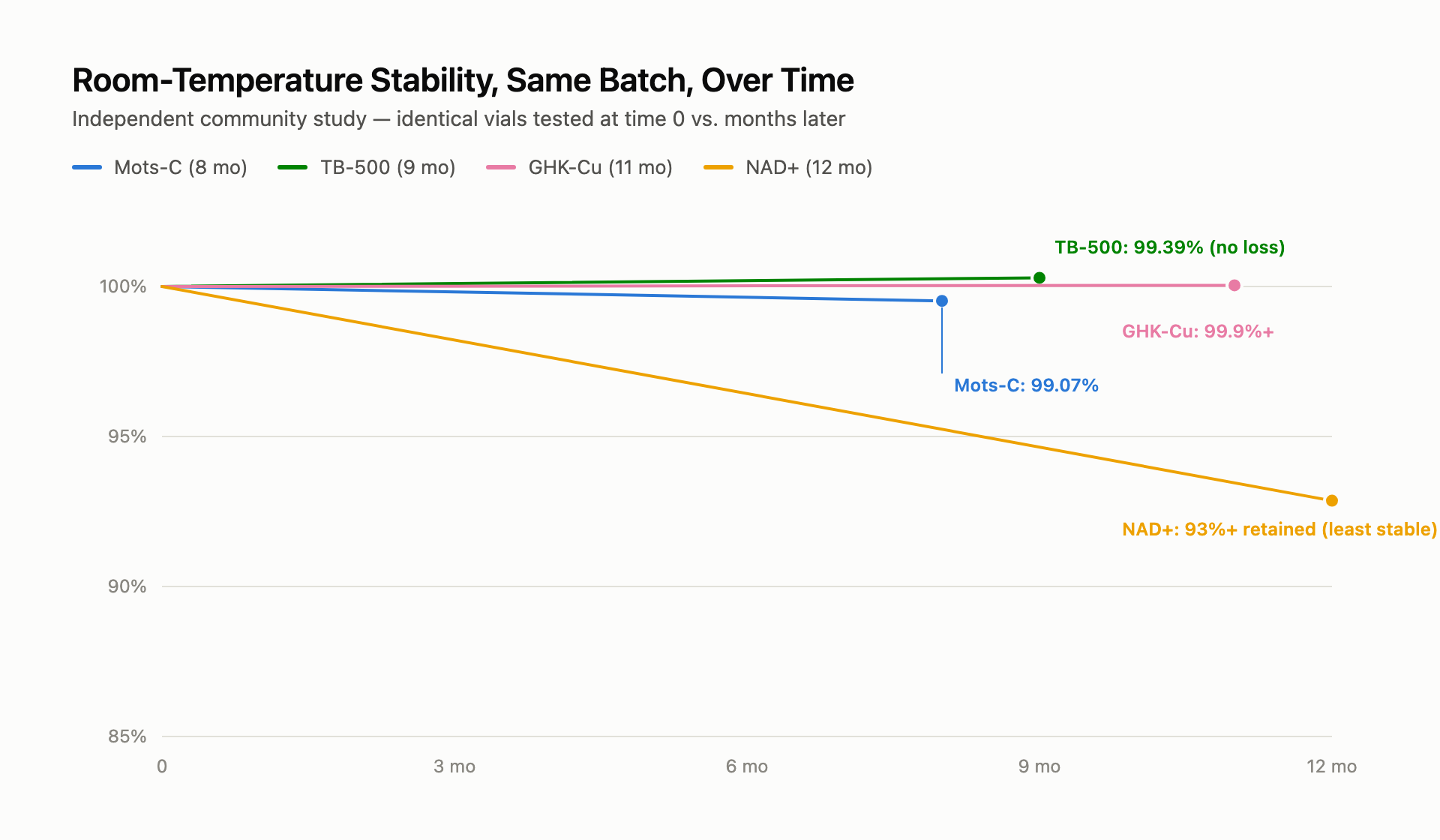
There’s also a solid independent community study worth mentioning. Identical vials from the same batch, tested once immediately and once after months at room temperature. Mots-C held 99.07% purity after 8 months, down from 99.55%. TB-500 showed no meaningful loss after 9 months. GHK-Cu held over 99.9% purity after nearly a year. Even NAD+, the least stable of the group, retained over 93% of its content after 12 months.
The takeaway isn’t “room temperature is fine, skip the fridge.” It’s that quality lyophilized peptides are more robust than the scarier community myths suggest, while refrigeration is still correct best practice, not superstition.
One rule with no nuance: never freeze a reconstituted peptide. Ice crystal formation physically destroys the molecule’s 3D structure. That’s irreversible.
And here’s the part people skip over: sterile technique matters more than storage temperature does. Most “peptide went bad” stories aren’t chemical degradation. They’re contamination introduced during handling. Every needle puncture into a vial is a potential entry point for bacteria, which is exactly why the 28-day rule exists in the first place.
The habits that actually protect you. Wipe the vial’s rubber stopper with a 70% isopropyl alcohol swab before every single puncture, not just the first one. Let the alcohol fully dry, 10 to 15 seconds minimum, before inserting the needle, since wet alcohol can get carried into the vial and defeat the whole purpose. Use a fresh, sterile needle and syringe every time you draw from a vial, never reuse one. Work quickly, keeping the vial capped as much as possible. Every extra second it’s open is more exposure to contamination.
This is also literally how you make your peptides last longer, not just safer. Bacteriostatic water’s preservative is what allows a reconstituted vial to survive roughly 10 to 15 punctures over that 28-day window. But that protection only works if you’re not introducing contamination faster than the preservative can handle. Sloppy technique can turn a peptide that would’ve been perfectly good for weeks into something contaminated in days. Good sterile technique is the single biggest factor within your control for actually getting the full shelf life out of what you paid for.
Bottom line: lyophilized peptides are tougher than people think, reconstituted peptides need real discipline, and sterile technique, not the fridge, is your actual first line of defense.
None of this is meant to scare you off. It’s definitely not meant to oversell you either. It’s the stuff I wish someone had laid out clearly for me before I started. Got a question that’s not on this list? Get in touch. That’s exactly what got this whole thing started in the first place.
For research use only. Nothing here is medical advice.
Shop: First Alarm Health